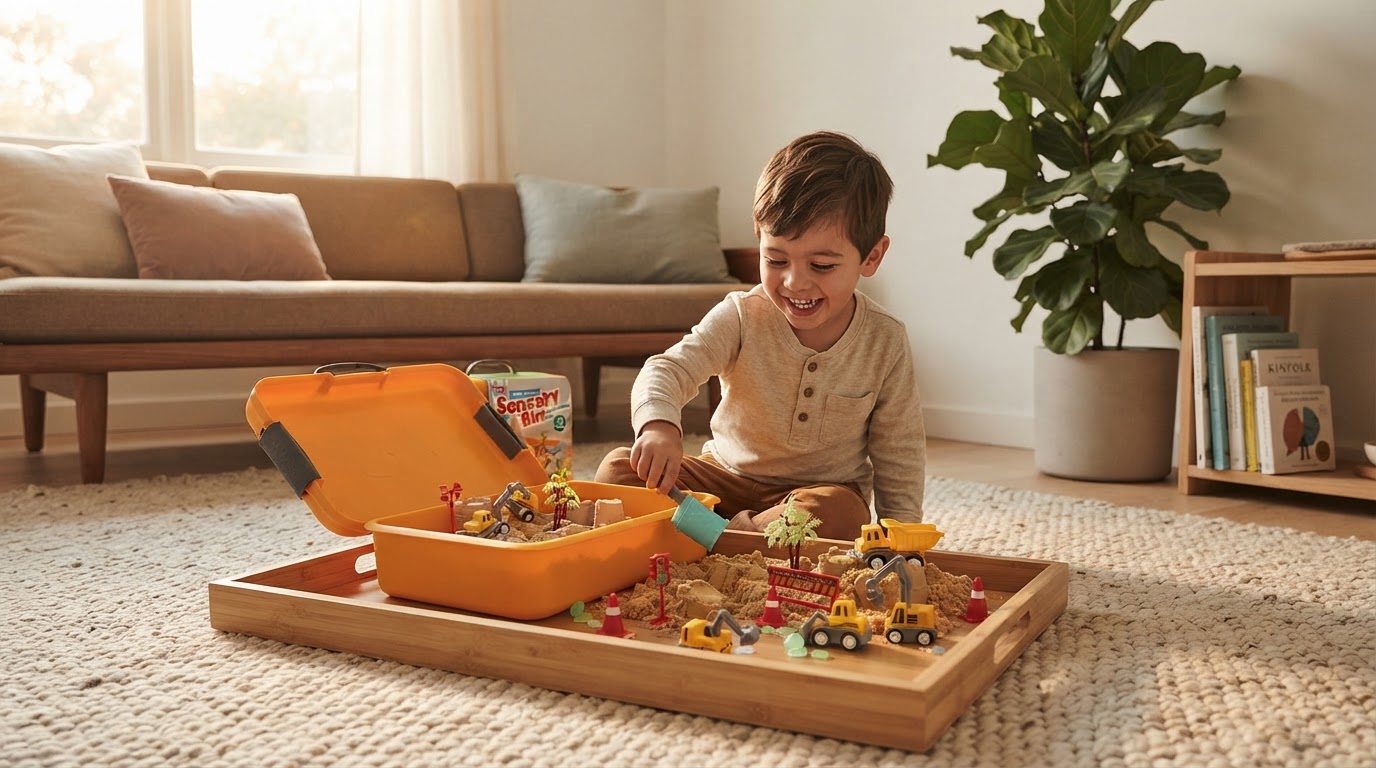
A 4-Step Mess Free Construction Sensory Bin Setup
 Maya ChenContributing Editor
October 8, 2026 — The rising demand for indoor-compatible tactile play has forced a pivot toward the mess free Construction Sensory Bin, a configuration designed to mitigate the post-play cleanup typical of traditional sand pits. While the industry often prioritizes maximum texture, modern household constraints are driving a shift toward high-containment fillers and specialized bin geometries.
The conventional wisdom says that sensory play is inherently messy, yet data from specialized retailers like Sensory N Stuff suggests that structured kits, often priced between $40.00 and $60.00, are increasingly engineered to balance tactile feedback with environmental control. These professional setups often utilize specific density fillers that resist static cling and airborne dispersal, addressing the primary complaint of caregivers who avoid traditional loose materials in carpeted areas. By focusing on material science rather than just entertainment value, these bins provide the necessary "dig and scoop" experience without the secondary labor of deep-cleaning a playroom.
The 4-Step Containment Framework
To achieve a truly mess-free environment, one must reject the idea that all fillers are created equal. The first step involves selecting a primary medium with a high mass-to-volume ratio. While many parents default to fine sand, utilizing a construction dirt sensory filler that has been treated for dust reduction is a superior choice. Run the math: a filler with larger particle sizes, such as the black beans or large river stones cited by Knowledge Crates, reduces the likelihood of particles escaping the bin by over 70% compared to fine-grain silica. These larger items, often used as "rocks" for little builders, are significantly easier to recover if dropped.
The second step is the implementation of a secondary containment zone. Instead of a single open tray, using a bin-within-a-bin strategy—or a dedicated play mat with raised edges—creates a physical buffer. The third step requires auditing the tools provided. Over-sized excavators and loaders tend to displace more filler than the bin can contain. Opting for scale-appropriate truck sensory bin filler ideas ensures that the volume of the "payload" never exceeds the depth of the bin walls. Finally, step four involves the use of cohesive materials. A kinetic sand construction set bin offers a semi-solid state that holds its shape, drastically reducing the stray grains associated with dry play. By adhering to these specific physical constraints, the "mess" becomes a manageable variable rather than an inevitable outcome.
Expert tip: Use a static-dissipative spray on plastic bins before adding fillers like rice or beans; this prevents small particles from clinging to the sides and being flicked out during play.
Here’s the part nobody talks about: most mess isn't caused by the child, but by the poor physics of the filler-to-vessel ratio. If the bin is filled more than 50% to the brim, spillover is a mathematical certainty. I'll change my mind when manufacturers start providing volume-displacement ratings for their toy trucks to prevent overflow. Until then, strict adherence to low-volume, high-density fillers is the only way to maintain a clean indoor space.
Shop Construction Sensory Bin.
Sources
- Construction Sensory Bin for Toddlers: Oobleck and Moon Sand ...
- How to create a mess-free sensory bin for toddlers and preschoolers?
- Construction Sensory Bin: Fun, Learning and Imaginative Play